Phorion Protections brings file access authorization, process execution controls, and Phorion’s EDR telemetry into a single macOS endpoint security solution.
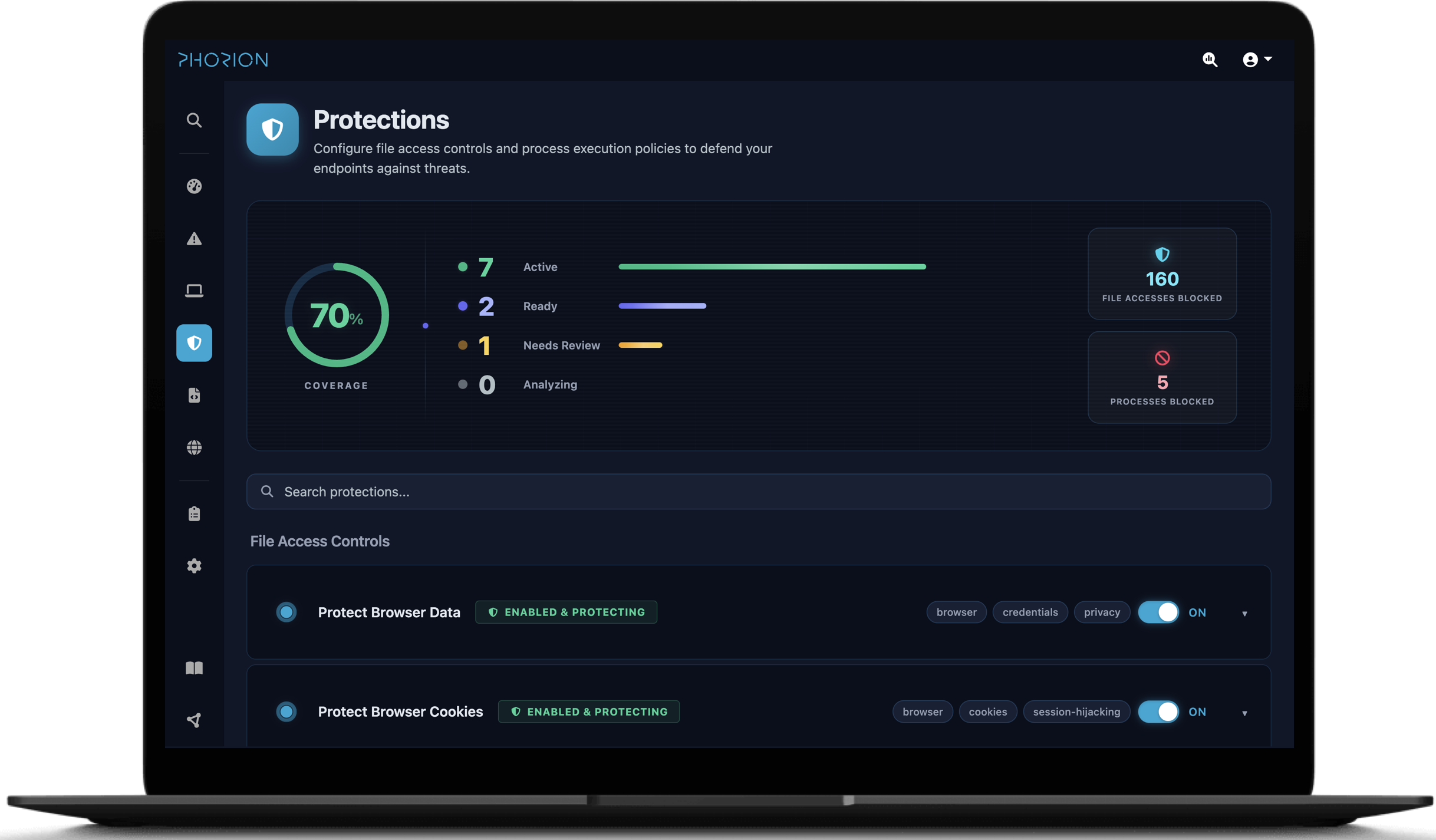
Protections is made up of two complementary hardening layers, each one closing off a different stage of the attack chain:
- Process execution controls shrink the attack surface. Block
curl,osascript,pythonor any other binary on the endpoints that don’t need them, and entire classes of stage-one payloads never get the chance to run. - File access authorization protects the data that matters. Browser cookies, SSH keys, and developer secrets are locked to the processes that legitimately touch them, so it doesn’t matter how an attacker reached the endpoint; your sensitive files are locked down.
Attackers are constantly evolving their tradecraft. New infostealers, new initial access vectors and new techniques appear every week. Protections doesn’t chase those TTPs. It defines what legitimate behaviour looks like on your endpoints, what processes should run and what files they should touch, and blocks everything else. The control holds regardless of how the threat is packaged.
The hard part is knowing what “legitimate” actually looks like in your environment, and this is exactly why it makes sense to build Protections upon the foundations of Phorion’s EDR. Every control is paired with historical analytics from the same telemetry your detections run on. Before you enforce anything, you can see how often the control would have fired, which users and devices it would have hit, and what normal behaviour looks like across your fleet.
Process execution controls
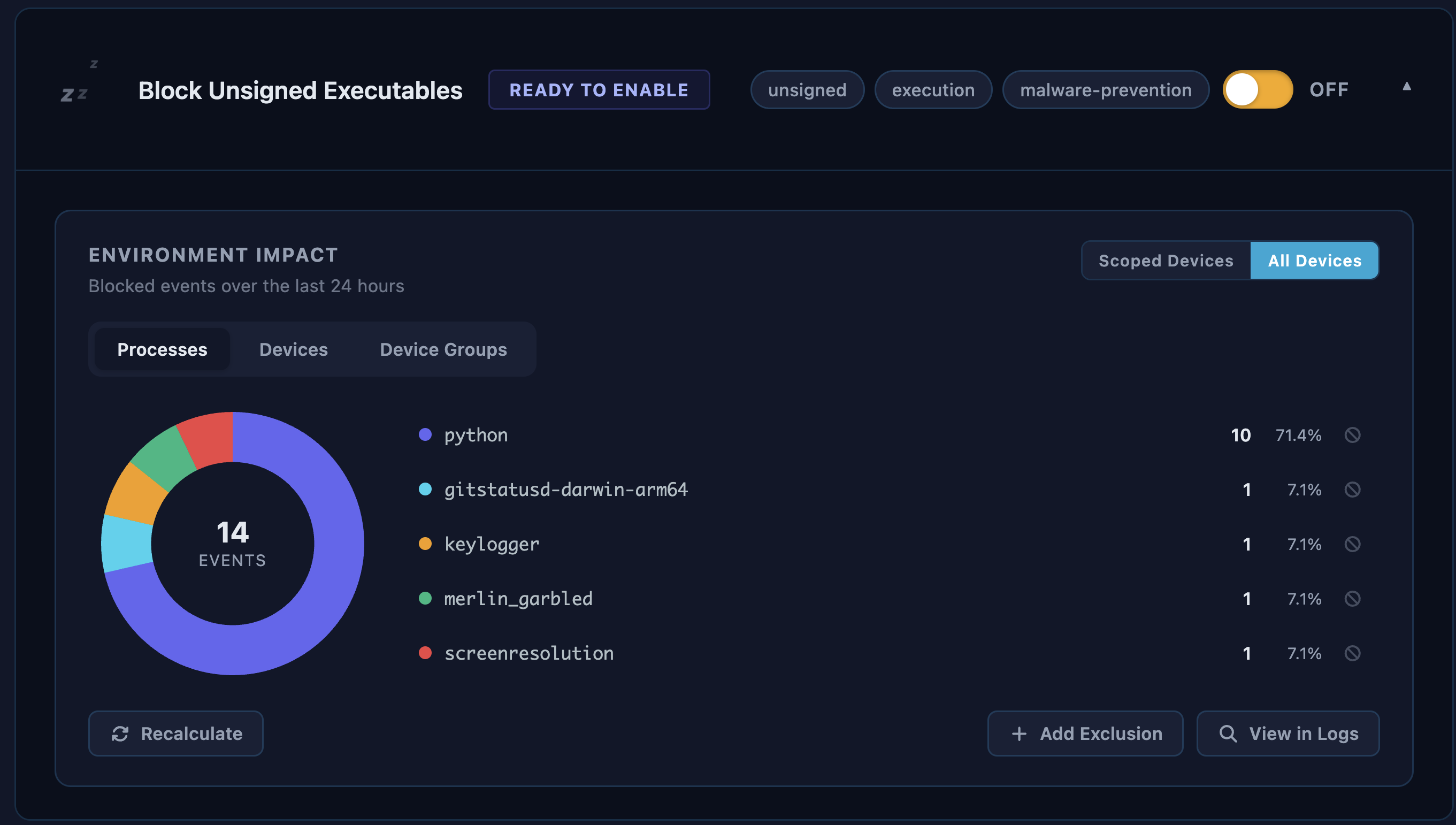
Process execution controls in Phorion lean into two complementary approaches, each one reducing the attack surface from a different angle:
- Blocking process flows that should never legitimately happen. Specific parent/child relationships, command-line patterns and signing combinations that have no business existing on a healthy endpoint. If a Word document spawns
bash, something has already gone wrong, so the control prevents the execution before it becomes an incident.
- Blocking tooling that isn’t required on the devices it’s running on. Does your marketing team really need
osascript,curlorpythonon their laptops? If not, blocking those binaries outright closes off entire classes of living-off-the-land technique on the endpoints where they were never needed in the first place.
The real power of these controls comes from how precisely you can scope them. Some users in your estate genuinely need osascript, curl or python to do their jobs. Many others do not. Without granular scoping, the populations that need those binaries force every device in the fleet to keep them available, and your protections fall back to the lowest common denominator. See Adapt to your environment for how Phorion handles this.
File access controls
Infostealers are the dominant macOS threat, and file access controls are one of the most effective ways to limit what they can reach. Browser cookies, developer secrets, SSH keys and credential stores get locked to the processes that legitimately touch them, and the rest of the system loses access by default. The attack surface around the data that actually matters drops sharply.
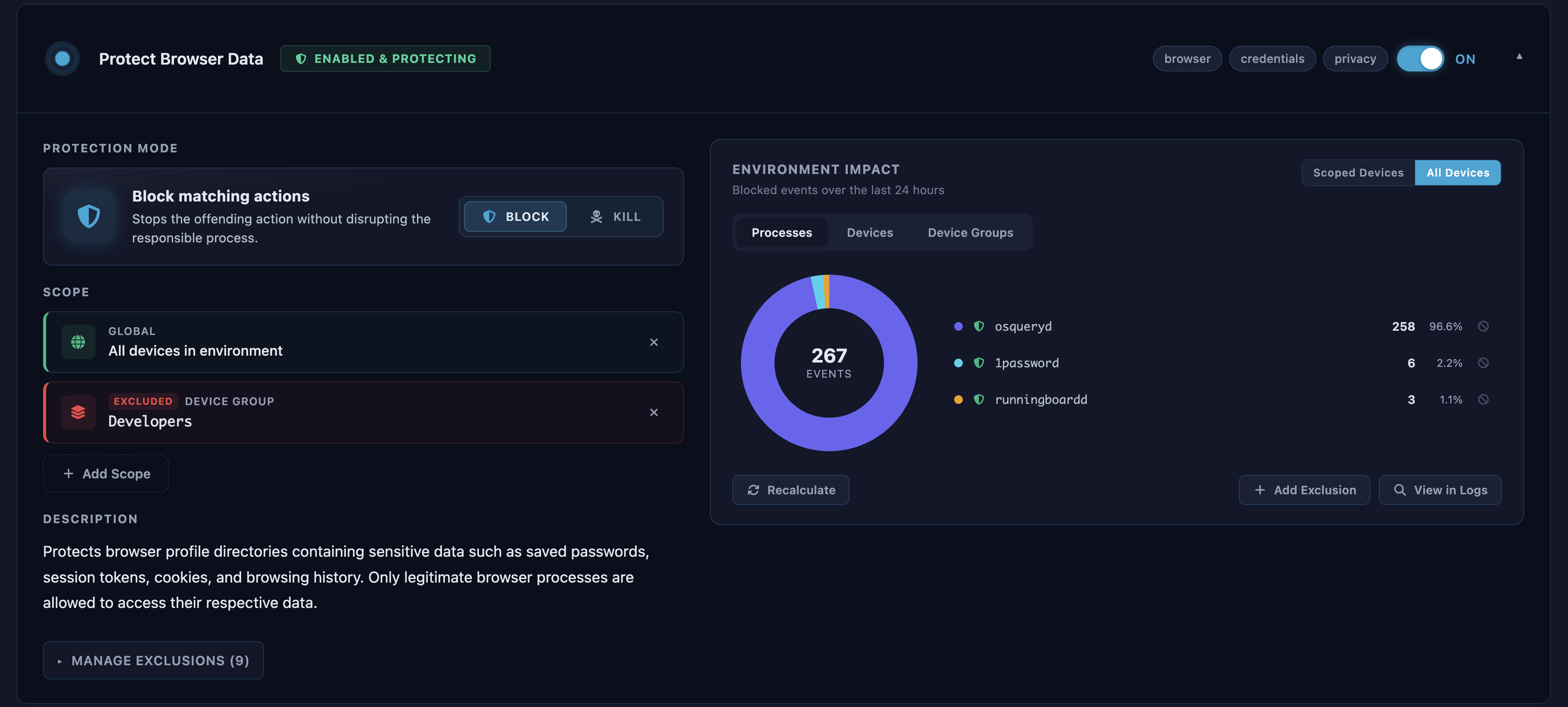
In practice, a file access protection has two parts: the paths to lock down, and the exclusions that define which processes are allowed to touch them. Here’s an example protection that covers Google Chrome’s on-disk data, with exclusions for the browser itself and for password managers that legitimately read it.
Equivalent protections ship for Safari, Edge, Brave, Arc, Opera and Firefox, each with their own browser and system exclusions, so the controls work out of the box across a typical macOS estate. Every exclusion is also gated on the process having a valid, trusted code signature, so a malicious binary that spoofs a known signing ID is still blocked because its signature won’t validate.
File access controls aren’t a new idea on macOS. Google/North Pole Security’s Santa and Phorion’s own cookie lockdown mechanism have excelled in this space for years. What’s been missing is a single tool that ties them together with the rest of your endpoint security. With Phorion Protections, file access authorization, process execution controls, and EDR telemetry live in one agent, one policy surface, and one investigation workflow.
Adapt to your environment
One size rarely fits all in enterprise environments. Phorion’s protections can be scoped to the devices and groups that need them, and tuned per rule with exclusions, so each control fits where it’s deployed.
Scope precisely
Security controls that fall back to the lowest common denominator leave gaps everywhere. If one development team needs curl or osascript, that doesn’t mean your marketing and sales teams do too. Likewise, if your endpoint management setup requires those binaries, they don’t have to be permitted unconditionally.
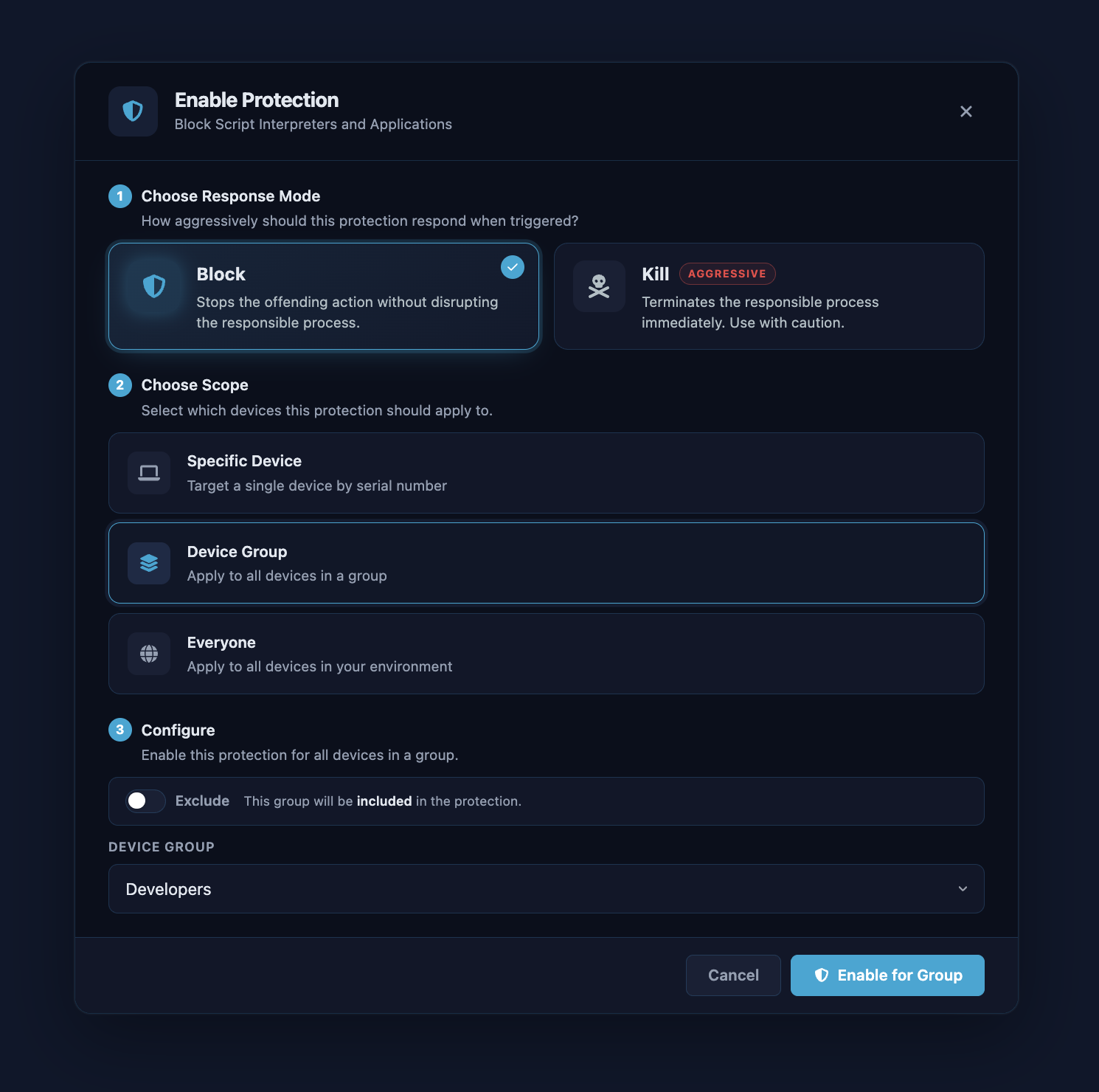
Phorion’s scoping handles both cases: apply a protection to a device group, target individual devices, or take a broad rule and carve out exemptions for specific groups or devices. Legitimate usage from administrative scripts can also be allowlisted, while the same binaries stay blocked everywhere else, all without maintaining two parallel policies.
Tune with exclusions
Every protection is paired with the analytics you need to build and validate exclusions confidently. You can see which users and devices a rule would impact, baseline what legitimate behaviour looks like in your environment, and add exclusions where they’re safe to enable.
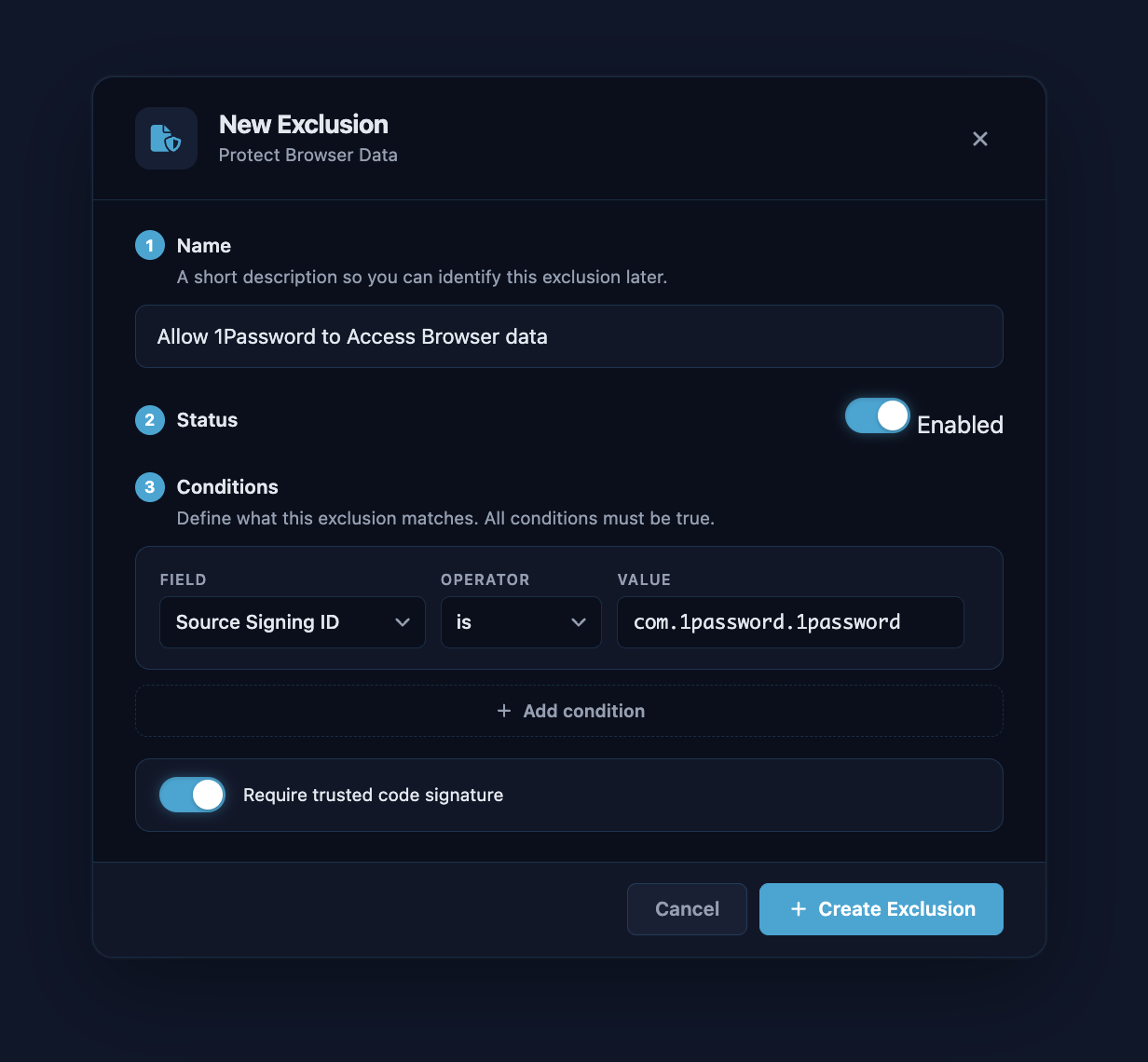
Phorion’s protections ship with default exclusions for known-good behaviour, and the analytics will flag whether a new exclusion you’re considering is safe before you enable it.
Layered defence
Responsible security means acknowledging silver bullets do not exist. Motivated attackers will find ways to bypass individual controls, so the goal is to stack independent layers and drive up the cost of exploitation at every stage. Phorion approaches that across four complementary layers:
- Prevent known malware with a best-in-class malware engine, integrated through our partnership with DoubleYou, so commodity threats never get the chance to execute in the first place.
- Reduce the attack surface with process execution controls, blocking tooling that endpoints don’t need and process flows that should never legitimately happen.
- Cut off attack paths with file access controls. Browser cookies, secrets and credential stores are locked to the processes that legitimately touch them, even after an attacker reaches the endpoint.
- Detect what warrants human analysis with Phorion’s EDR, so behaviour that doesn’t justify an outright block still surfaces for review.
Phorion Protections brings prevention and detection together on a single agent, so defenders move at the same pace as attackers.
Get in touch to arrange a demo and see Phorion Protections in your environment.